
Venezuelan Society of Ecology
Who we are
The Venezuelan Society of Ecology (Sociedad Venezolana de Ecología, SVE) is a non-profit Civil Association founded in 1985. The Society was created with the aim of promoting, encouraging, and contributing to scientific knowledge, conservation, and management of the ecosystems of Venezuela and of the tropics in general, through the dissemination of the results of ecological research in these areas. In this sense, the Society intends to act as an important link in facilitating communication among the leading figures of ecology in Venezuela and the institutions linked to the different disciplines in this field.
Historical account of the Society
Written by: Professor Zdravko Baruch
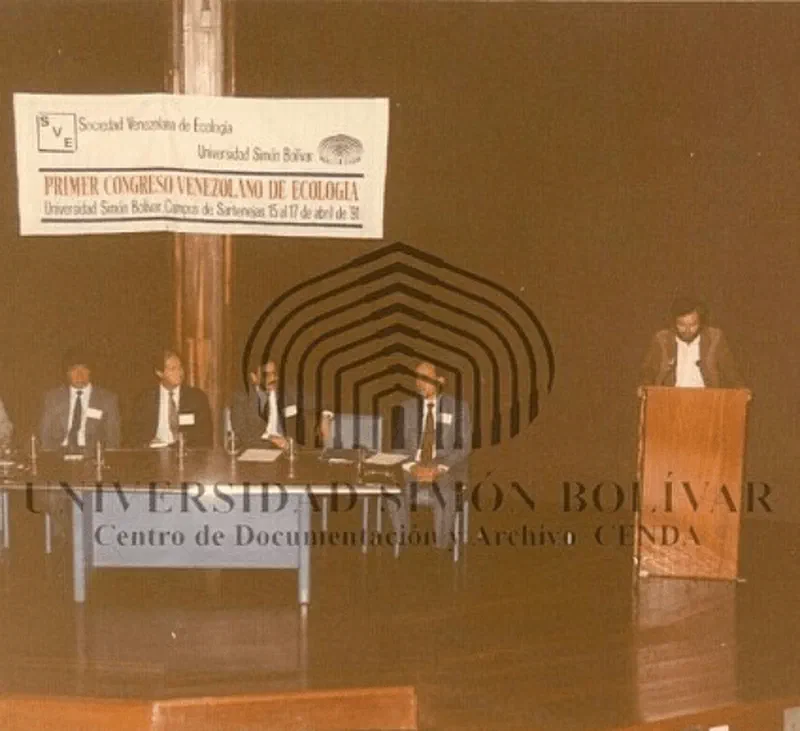
This account is my version of the founding and early years of the SVE. Considering that some important acts and decisions, as well as the names of colleagues and collaborators, slipped my mind, I apologize in advance.In the mid-1980s, several professors from the USB, among them Antonio Vivas (RIP) and Roger Carrillo, thought it would be a good idea to have a society that brought together those of us who work in ecology and share common interests and similar views regarding the management of the environment and its resources. We then called on colleagues, mostly from the UCV. There, Claudia Cressa, Santiago Ramos, and José Ochoa joined us.After several preparatory meetings, we decided to constitute the Society. The Legal Advisory Office of the USB helped us draft the corresponding Founding Act (which can be downloaded from the Society’s website), which was duly registered. With it, we applied for the tax ID (RIF) and opened a savings account at Banco Mercantil. Each of us invited colleagues from our own and other institutions to join.The first objective was to create the scientific journal. Through collective brainstorming, we named it Ecotrópicos. Claudia was the journal’s first editor, and Roger was in charge of contacting a typesetter and printer for us. His print shop was in El Rosal, as I remember because I had to visit him many times to correct galley proofs. Nobody knew how the process worked, so we learned by doing as we went. The first issue did not come out so badly, I think. Except that one of the pages came out printed upside down!We already had a considerable number of colleagues in most of the universities and at IVIC. We would distribute the journals and each of us would hand-deliver them to subscribers and collect the fees. By 1992 or 1993, CONICIT granted us an award for the publication, but I do not remember when it began subsidizing it. Our main problem was that we did not receive enough manuscripts and that reviewers took too long to respond. On top of that, authors also took too long to make the suggested corrections and to resubmit their work. Claudia must have many anecdotes about that. I understand that Ecotrópicos is going through a difficult period due to the lack of subsidies. Digital publication could be the solution to this problem.Another task of the Society was to promote scientific meetings. The First Venezuelan Congress of Ecology was held at the USB, which gave us its full support. Organizing it fell basically to me, with the help of José Gómez, a USB graduate. We photocopied the programs and abstracts in my laboratory, where we stapled them so we could hand them out on the day of the event.I believe it was a success. We held it in the newly inaugurated Conjunto de Auditorios, using the four halls simultaneously. Organizing and putting on an event of that kind is truly a unique experience. Students from the Tourism and Hospitality program at the Núcleo del Litoral of the USB took charge of all the logistics. They did a great job.We also invited four international keynote speakers. We asked them to speak slowly so that their English would be understandable to most attendees. At the closing of the Congress, a big party was held at the Casa del Profesor of the USB. The drums of Naiguatá came to perform. It went on until the small hours, and around the middle of the night they had to take up a collection to buy more drinks because they ran out quickly (a sign of good ecologists!). It was a huge crowd.It is quite an achievement that the Society’s biennial Congress has been maintained so successfully over all these years. A question that arises is why, of the many works presented at the Congress, so few end up being submitted for possible publication in Ecotrópicos? It is an excellent topic for discussion and analysis.The third objective of the Society — to speak out on the country’s environmental problems and offer solutions — never came to fruition. Several times we called on members to discuss the issue, but very few attended. This situation, with a few exceptions, persisted for far too long. I hope the new Board of Directors will be more successful in that task.